



SA Secular Society member Emma Campbell unpacks an aspect of critical thinking.
Someone tells you that a particular treatment works. A friend recommends a product that supposedly has remarkable effects. You see a post online claiming that something happened, or that a particular person, organisation or government is responsible for it. How do you decide whether to believe it?
Often, our first response is instinctive. We might believe the person because we trust them. We might dismiss the claim because it sounds ridiculous. We might be persuaded by a compelling story, an impressive-looking graph, or the fact that hundreds seem to agree.
But we can ask a different question: What is the evidence?
What counts as evidence?
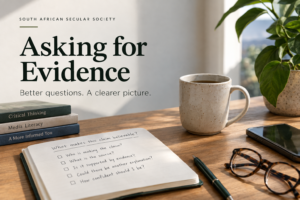
Evidence is information that helps us determine whether a claim is likely to be true. It can support a claim, challenge it or leave us uncertain. But other things that can look like evidence.
An assertion is simply a statement that something is true. Saying, “This treatment works,” is not the same thing as demonstrating that it works.
An opinion is what someone thinks. Opinions can be informed and valuable, but they aren’t automatically evidence for the thing being claimed.
An anecdote is a personal experience. If someone tells you, “I tried this and it worked for me,” they may be telling the complete truth. Their experience is real. But it doesn’t necessarily tell us what caused the outcome or whether the same thing will happen to other people.
A sincere person can be sincerely mistaken. We can misremember events, misunderstand what happened, overlook other explanations or see patterns where none exist.
Why bother asking?
We live in an environment designed to persuade us. Advertising wants us to buy things. Politicians want us to support particular ideas. Social media rewards content that attracts attention.
We can be influenced by confidence, repetition, authority, emotional stories and the opinions of people we like. We are also particularly good at noticing information that confirms what we already believe while overlooking information that challenges it.
Asking for evidence creates a small but valuable pause between hearing a claim and accepting the claim.

Not all evidence is created equal
Imagine someone tells you that a particular supplement dramatically improves memory. They show you a testimonial from someone who says it changed their life. That’s evidence of something: that this person believes the supplement helped them. But it doesn’t necessarily establish that the supplement caused the improvement.
We might ask:
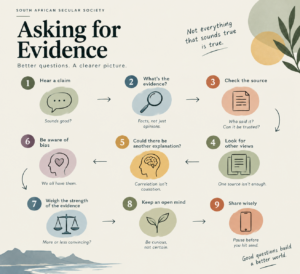
- Where did the evidence come from?
- How was it collected?
- Can the source be trusted?
- Has anyone else investigated the claim?
- Has it been independently tested?
- Could there be another explanation?
- Does the evidence support the specific claim?
These questions can be applied to almost anything.
“But it happened to me”
Personal experience is powerful. If you take a particular remedy and your headache disappears afterwards, it is entirely understandable to conclude that the remedy worked. However, there’s a difference between “X happened, and then Y happened” vs. “X caused Y.”
Could something else explain what happened?
This is the basic problem of confusing correlation with causation. Two things happening together doesn’t necessarily tell us that one caused the other.
Evidence doesn’t have to mean certainty
One of the most useful misconceptions to abandon is the idea that we either have proof or we have nothing. Most of the decisions we make don’t come with absolute certainty.
Try to proportion your confidence to the strength of the evidence. If the evidence is strong, it makes sense to be more confident. If there isn’t enough evidence to decide, “I don’t know” is a perfectly reasonable answer.
In fact, being comfortable saying “I don’t know” is an important part of intellectual humility.
What about extraordinary claims?
Some claims are relatively ordinary. Others would require us to radically change our understanding of how the world works.
If someone tells you they bought a particular brand of running shoes and found them comfortable, you probably don’t need an elaborate investigation.
If someone claims that a miracle has occurred, that they have discovered a cure for a serious disease, or that a vast and complex conspiracy has been secretly operating for decades, the stakes are rather different.
Evidence in the age of social media
This becomes particularly important online. A post can have thousands of shares and still be wrong. Before sharing something, we can pause and ask:
- Who is making this claim?
- What is their source?
- Can I find the original source rather than someone’s interpretation of it?
- Does the evidence actually support the headline?
- Are independent, reputable sources reporting the same thing?
- Is this a fact, an interpretation, or an opinion?
Sometimes the answer will be reassuring. Sometimes we’ll discover that a claim is much less certain than it first appeared.

Being willing to change our minds
Perhaps the most important part of asking for evidence is what we do when the evidence doesn’t support what we previously believed. Critical thinking requires us to apply the same standards to ourselves. If good evidence contradicts something we believe, we have a choice: we can look for ways to dismiss it, or we can reconsider our position. Changing your mind can be evidence that your thinking is working.
A secular approach to the world does not require us to reject every claim that cannot be immediately proven, nor does it require us to believe nothing at all. Rather, it encourages us to remain curious about what we know, how we know it and how confident we should be.
Asking for evidence is therefore about cultivating curiosity, humility and intellectual honesty.
Good questions don’t weaken our understanding of the world. They help us build a better one.