
SA Secular Society member Sacha Smith considers a humanist approach to heritage.
We look back because we want to understand where we came from. The past wasn’t always better, and revisiting it can be uncomfortable. But understanding where we come from helps us make sense of who we are.
Heritage
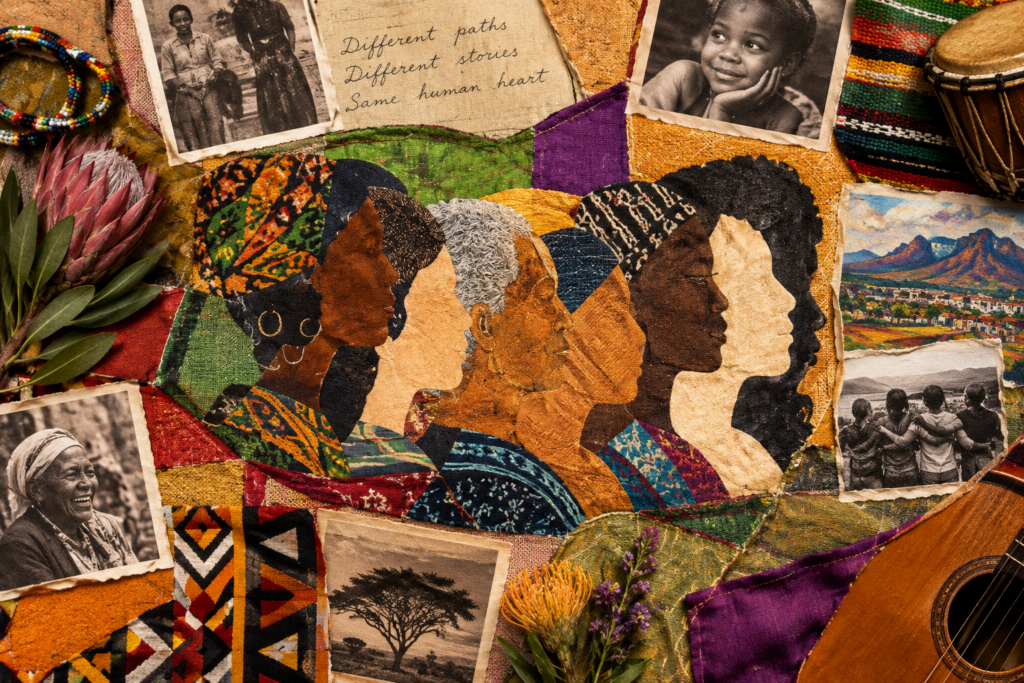
Heritage is often presented as something grand: monuments, museums, old buildings, and traditions passed down through generations. Yet most of us experience it in simpler ways. A phrase a grandmother used. Food that appears at family gatherings. A song everyone knows. Stories told and retold, changing slightly each time.
We often inherit these things almost accidentally. We don’t hold on to everything we’re given. Some things remain because they still have meaning. Others disappear because nobody keeps them going. Often, we don’t even realise we’re making these choices. That is part of how culture works.

Heritage is sometimes discussed as though respecting it means keeping it exactly as it was. But culture has never been fixed. It changes as people, ideas, and influences meet. South Africa is a good example. Countless influences have shaped its culture over centuries.
Age alone isn’t necessarily a reason to preserve something.
History
Looking back in South Africa isn’t simple. Colonialism, apartheid, forced removals and inequality are part of our heritage too. We take pride in our history, but we also have to confront the pain honestly.
The Voortrekker Monument is a good example. For some, it represents Afrikaner heritage; for others, it can be a painful reminder of exclusion and apartheid-era nationalism. Heritage can therefore raise difficult questions about what we remember, what we preserve, and whose memories we represent.

Turning heritage into nostalgia is risky. We can value where we came from without pretending the past was simple or that everyone experienced it in the same way.
The arts
The arts give these conversations a human face. History tells us what happened. A song or photograph can make history feel less distant and let us see through someone else’s eyes. Think of Miriam Makeba’s voice or Abdullah Ibrahim’s piano. Their music carried the experiences of a country divided by apartheid, exile, and change. Even the graffiti on a city wall tells a story about who we are and what matters to us.

Art doesn’t give the whole truth, since artists have their own views and biases.
Today, everyone is an archivist. We photograph ordinary moments, record videos, create playlists, and leave behind thousands of digital traces. Most of it probably won’t matter.
But some of it will.
Future generations may look at our digital records and discover things never intended to become part of history. They’ll see how people dressed, what they ate, what made them laugh, and what they couldn’t stop talking about. They may even wonder why so many meals needed photographing.
We cannot know what story future generations will tell about us. We leave behind evidence, but its meaning comes later, in the hands of people who never knew us.
Heritage and humanism
This is where Humanism offers an interesting perspective. Humanism does not require meaning to come from outside humanity. We create meaning through our relationships, experiences, creativity, and the ways we contribute to others’ lives.
A secular society can still have meaning, tradition and ceremony. People marry, remember those they’ve lost and create their own ways of marking important moments. These things don’t need a religious explanation to matter.
The same is true of heritage. Perhaps heritage is not simply about what we inherit. It is also about what we choose to carry forward, what we leave behind, and what we create for those who come next.