




An Interview with the Author – Synthil Kistnasami
Tell us something about yourself and your beliefs, if any.
Today, I identify as a Humanistic Atheist, I am not convinced of the existence of a God or any supernatural being, nor do I worship deities or manifestations of divinity. Yet my identity is inseparable from my Hindu heritage. Born to Hindu parents, I find resonance in Hinduism not as a religion of worship, but as a way of life – expressed through our dress, food, music and cultural traditions. For me, Hinduism is a civilisational framework, a cultural compass that shapes identity and community, rather than a system of supernatural beliefs.

What inspired you to write this book?
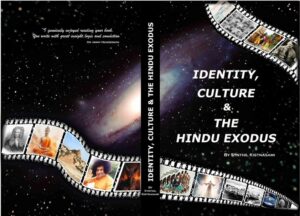
The inspiration arose from lived experience – growing up in Durban, witnessing the migration of Hindu families, and sensing the erosion of culture identity. I often wondered, why so many Indian people – especially those born into Hindu families -, abandon their ancestral faith and convert to Abrahamic religions such as Christianity, Islam, Jehovah Witness and Mormonism. Despite growing up immersed in Hindu traditions, I could not grasp what compelled so many to leave a religion that shaped their upbringing. I wanted to preserve these stories not as nostalgia, but as testimony to resilience and continuity.
What was your motive for writing the book?
My motive was to document the Hindu exodus as both a cultural and historical phenomenon. Our ancestors came to South Africa as part of the Indian diaspora, often under difficult circumstances. Many arrived with only fragments of understanding about Hinduism- rituals without philosophy, customs without context. They did their best, but the transmission was incomplete. Generations grew up with diluted knowledge, and in the absence of clarity, confusion took root. That confusion has now become rejection, while offering a lens to understand the broader struggle of identity in a world of shifting beliefs and conversions.
How can the book help society facing conversion pressure?
It provides a framework for dialogue. By tracing the roots of identity, the book reminds communities that culture is not fragile – it is adaptable. It encourages education, self-awareness, and pride in heritage as tools against coercion.
Why is science central to a humanistic or atheist view?
Science offers universality. Where dogma divides, science unites through shared laws of nature. It becomes the foundation for a humanistic worldview, one that values reason, compassion, and the dignity of inquiry.
How did your upbringing shape your perspective?
Growing up in Chatsworth and later working in Johannesburg exposed me to both the rootedness of tradition and the pull of modernity. These contrasts sharpened my awareness of identity as both inherited and chosen.
What role does cultural heritage play in resisting conversion?
Heritage is a compass. Rituals, festivals, and stories remind us of who we are. They anchor communities in belonging, making conversion less about persuasion and more about survival of meaning.
Why weave science into cultural narrative?
Because culture without inquiry risks stagnation. By integrating Feynman’s ideas and conservation laws, I show that science is not opposed to tradition – it enriches it, offering new metaphors for existence.
What lessons from the Hindu Exodus resonates globally?
I use the analogy to describe the Hindu exodus, but here, the journey is not from Egypt to Israel. It is from Hinduism to Christianity. Many Hindus, often without deeply studying their own scriptures or traditions, are persuaded to leave behind their ancestral faith and embrace Christianity. They are told that Christianity is the “promised land”, offering salvation and truth. Migration is universal. Whether forced or chosen, it carries themes of loss, adaptation and renewal. “The Biblical exodus led to a promised land. The Hindu Exodus risks leading to a borrowed land- one that may not truly belong to those who leave without knowing what they already have.” This mirrors countless human journeys, reminding us that identity is portable yet vulnerable.
How do reinterpretations of ancient texts help modern readers?
They breathe relevance into myth. By re-reading ancient texts through modern eyes, we discover timeless wisdom about cycles of existence, resilience, and the human search for meaning.
What do you hope readers carry forward?
I hope to carry a renewed pride in identity, a curiosity for science, and to trace the historical journey of Hinduism, but to speak directly to those who may be questioning their spiritual path. This includes Hindus who are considering conversion to another religion, those who feel undecided or conflicted, and seekers who stand on the fence between faiths. In a world where religion is often marketed, politicized, or misunderstood, I wanted to remind readers – especially Hindus – of the quite strength and timeless wisdom they already carry. The book is not an end, but a beginning- a spark for reflection and action.
How did personal relationships influence our writing?
Dedications are not ornamental; they are lifelines. My late brother-in-law’s memory, my spouse Irene’s support, and my children contributions gave the manuscript its emotional heartbeat.
How did your family’s support shape the final manuscript?
It was a collective effort. Irene’s typing, Christopher’s proof reading, Donovan’s design- each act of support transformed the book from solitary vision into shared creation.
Read our interview with the author of Modern Humanism.