


SASS member Emma Campbell considers some aspects of freedom of expression in South Africa.
Freethinking begins with the freedom to question. Humanism takes that freedom and places it within a broader commitment to human dignity, autonomy and flourishing. Both depend on an open exchange of ideas.
Freedom of expression is therefore more than a political right. For freethinkers and Humanists, it is part of the intellectual freedom that allows people to examine beliefs, challenge authority, exchange ideas and change their minds.
That does not mean every form of expression should be protected in every circumstance. A free society has to balance freedom of expression with other rights and with protection from genuine harm. But without a strong presumption in favour of open discussion, neither freethinking nor a healthy democracy can flourish.

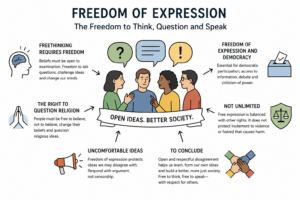
Freethinking Requires Freedom
At the heart of freethought is a simple principle: beliefs should be open to examination.
A freethinker asks questions. What is the evidence? Is the argument sound? Are there other explanations? What would make us change our minds?
But questioning is only meaningful when people are actually free to ask those questions.
If certain ideas cannot be discussed, if criticism of authority is prohibited, or if people are punished for expressing unpopular conclusions, independent thought becomes much more difficult. This is why freedom of expression and freedom of thought are so closely connected. Humanists International’s Oxford Declaration on Freedom of Thought and Expression describes the ability to develop, examine, change and express one’s beliefs as fundamental to human dignity and freedom. It protects both religious and non-religious worldviews.
The Right to Question Religion
This principle is particularly important to secular societies.
Freedom of religion means that people should be free to hold and practise their religious beliefs. But freedom of thought also means that people should be free not to believe, to change their beliefs, and to question religious ideas.
Freedom of Expression and Democracy
Freedom of expression is also essential to democracy.
To meaningfully participate in public life, citizens must be able to access information, debate ideas or criticise those in positions of power.
The South African Constitutional Court views freedom of expression as central to democracy. It has recognised its importance not only for democratic participation but also for individual moral agency and society’s search for truth.
Democracy requires disagreement. It requires people to be able to say that the government is wrong, that a law is unjust, that a majority is mistaken or that a long-established social practice should change.
Does Free Expression Mean Anything Goes?
Freedom of expression is a fundamental right, but it is not unlimited. Section 16 of the South African Constitution specifically excludes propaganda for war, incitement of imminent violence, and advocacy of hatred based on race, ethnicity, gender or religion where it constitutes incitement to cause harm.
The Constitutional Court states that freedom of expression coexist with other constitutional values, including human dignity and equality.
We can ask ourselves: “Does restricting this expression genuinely protect the rights of others, and is that restriction justified?”
The Importance of Uncomfortable Ideas
One of the hardest things about supporting freedom of expression is accepting that it protects ideas we may disagree with. We can respond to an idea we dislike by argument rather than censorship.
To conclude
Freethinking asks us to examine our beliefs. Humanism asks us to use reason, compassion and human values in deciding how we live.
Freedom of expression allows us to ask difficult questions, challenge inherited ideas, criticise institutions, defend unpopular positions and listen to people who see the world differently from us.
Open (and respectful) disagreement is one of the ways we learn, form our own ideas, and do better. A society in which people are genuinely free to think for themselves must also be a society in which they can express those thoughts openly, subject to reasonable protections for the rights and safety of others.
Read more about freethinking and humanism here.