




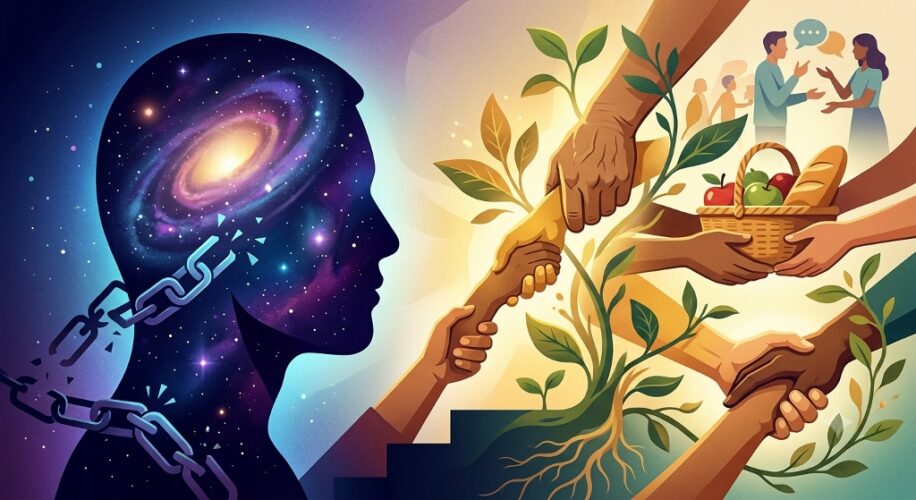
SA Secular Society member Emma Campbell provides some insight into these two ways of thinking and living.
The terms Freethinker and Humanist are often used interchangeably. While they are similar in many, overarching ways, they contain some differences.
Both terms centre themselves around reason, evidence and intellectual freedom, and both have played an important role in the development of modern secular society. Yet they describe different aspects of a person’s outlook. Freethought is primarily an approach or way of forming beliefs, while Humanism is a broader ethical philosophy about how we should live (among other people).
Freethought
Freethought is not primarily a philosophy of life or a fixed set of beliefs. Instead, it’s an approach to forming beliefs based on reason, evidence and critical enquiry.
A freethinker seeks to evaluate ideas using reason, evidence and critical thinking rather than accepting them solely because they are supported by tradition, authority or popular opinion. Freethought encourages questions, thinking and rethinking.
Independent enquiry is an important component of Freethought. This means that freethinkers can come from a variety of backgrounds, beliefs and cultures. Freethinkers are united by a commitment to intellectual honesty, open enquiry and freedom of thought, rather than by particular beliefs.
We have Freethought to thank for many of the values associated with modern democratic societies, including freedom of conscience, freedom of expression and the principle that no claim is beyond critical examination.
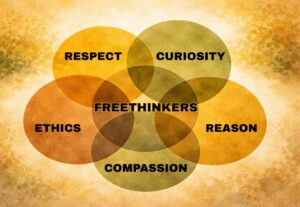
Humanism
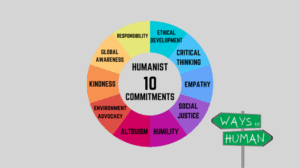
Humanism shares many of the values of Freethought, but it goes further by offering a positive ethical philosophy.
Humanists believe that human beings are capable of living meaningful, ethical lives without relying on supernatural beliefs. Rather than looking to divine authority for moral guidance, Humanists emphasise reason, empathy and a concern for human wellbeing.
Humanists support equal rights and opportunities for everyone. Democracy, scientific enquiry, and freedom of conscience are key tenets of Humanism.
Freethought is mainly concerned with how beliefs are formed while Humanism also asks how we should treat one another and in what kind of society we should live.
Where Freethought and Humanism Overlap
These philosophical standpoints encourage critical thinking and scepticism towards unsupported claims and to abuse of power. Both view science as a central and reliable method for understanding our world. They recognise that rigorous questioning, reasoning and discussing are fundamental to forming a just society.
Many humanists identify as freethinkers because they approach ethical and philosophical questions with the same commitment to reason and evidence.
Both philosophical standpoints have also contributed to the defence of secular government.
Different Questions and Purposes
Freethought asks: How should we decide what is true?
Its focus is on the methods we use to evaluate claims and form beliefs.
Humanism asks: How should we live?
Its focus is on developing an ethical framework that promotes human flourishing, compassion and responsibility. Thus, you can be a Freethinker without being a Humanist. It’s also possible to apply critical thinking while following a religion or worldview.
While most contemporary humanists value freethought, Humanism is more than a commitment to critical thinking. It’s a philosophy focused around wellbeing, dignity and our collective responsibility to improve the human condition.
Humanism and Freethought are complementary rather than identical.
In South Africa
Our Constitution protects this country’s diversity by guaranteeing numerous freedoms, including those of religion, thought and expression.
Freethought supports the above by defending one’s right to question and think critically without fear of discrimination. Humanism builds on these same freedoms by promoting a society grounded in equality, human dignity, compassion and respect.
Secularism provides the constitutional framework that allows different worldviews to coexist. By remaining neutral in matters of religion, the state protects both religious liberty and freedom from religious coercion, ensuring equal citizenship regardless of belief.

To Conclude
Freethought and Humanism are closely connected but contain small differences. Freethought encourages us to think critically and question assumptions. Humanism builds upon that commitment to reason by offering an ethical philosophy centred on human wellbeing, compassion and shared responsibility.
Together, they represent two complementary views within the broader secular movement. One focuses on how we arrive at our beliefs; the other focuses on how we choose to live.
The South African Secular Society hopes to contribute to a society that is both more rational and more compassionate by encouraging critical enquiry, mutual respect and equal rights.
Sources
American Humanist Association. What Is Humanism? Available at: https://americanhumanist.org/what-is-humanism/definition-of-humanism/
Freethought Trail, Freethought / Atheism / Secular Humanism, https://freethought-trail.org/causes/cause:freethought-atheism-secular-humanism/
Humanists International. What Is Humanism? Available at: https://humanists.international/what-is-humanism
Wikipedia. Freethought. Available at: https://en.wikipedia.org/wiki/Freethought