
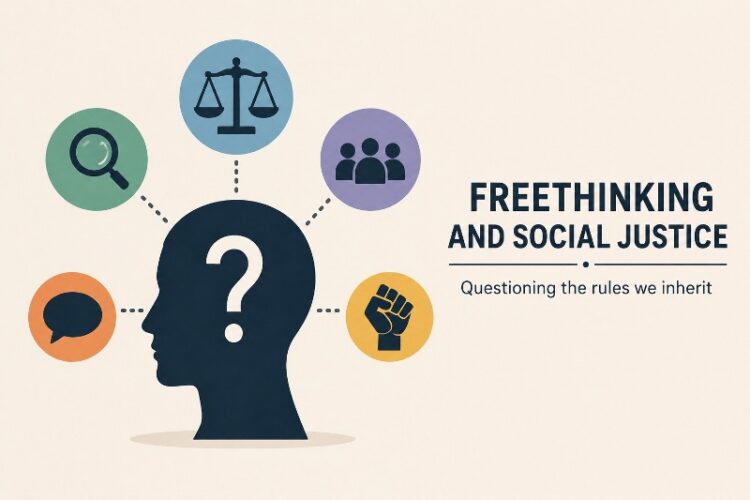
SA Secular Society member Emma Campbell turns her lens on social justice, from a Freethinker’s point of view.
Throughout history, many social institutions and customs have been defended on the grounds that they are traditional, natural or ordained by a higher authority. Freethinking challenges us to ask a different question: Are these ideas actually justified?
Freethought is a method of enquiry rather than a programme for social reform. But its commitment to questioning authority, examining evidence and thinking independently has often provided an important intellectual foundation for challenging injustice.
Questioning What We Take for Granted
Freethought begins with intellectual independence. A belief does not become true simply because it is ancient, popular or supported by an authority (supernatural or otherwise).
If a society says that some people are naturally inferior to others, a freethinker asks: “What’s the evidence?” If a tradition denies certain people political rights: “Why should this tradition say who deserves those rights?”
Freethinking encourages us to examine social arrangements that might otherwise be accepted/normal without question.

Challenging Authority
Freethought has historically been associated with criticism of religious and political authority, particularly when those authorities have claimed an unquestionable right to determine what people may believe or how society should be organised.
This connection became especially important during the Enlightenment, when thinkers increasingly questioned inherited political and religious authority and argued for freedom of conscience, individual rights and government accountable to its citizens.
But there is an important distinction. The Enlightenment was not a single freethinking movement, and its thinkers disagreed profoundly about religion, politics, economics and equality. Nor were all Enlightenment thinkers advocates of universal rights in the modern sense.
Freethought should therefore not be presented as the sole cause of modern social justice. The development of human rights and democratic societies involved many intellectual traditions, religious and non-religious, as well as political movements and ordinary people organising for change.
What freethought contributed was a powerful habit of questioning: Why should things remain this way simply because they have always been this way?

From Questioning to Action
However, we need more than critical thought to create a just society.
A person can reject religious authority and still hold prejudiced or authoritarian views. Freethought alone does not necessarily guarantee good political judgement, compassion or moral wisdom.
This is why the relationship between freethought and social justice is best understood as a connection rather than an equation.
Freethought can help us identify assumptions, scrutinise arguments and challenge unjustified claims. Social justice requires a commitment to equality, dignity and the reduction of unnecessary suffering, together with the political and social action needed to turn those principles into reality.
This is where freethought overlaps particularly strongly with Humanism.
A Humanist Response
Modern Humanism explicitly connects reason and free enquiry with human rights and social responsibility.
Humanists International’s current Declaration of Modern Humanism affirms the dignity and autonomy of individuals, supports democracy and universal human rights, rejects racism and prejudice and recognises a responsibility towards humanity as a whole. It also emphasises that knowledge must remain open to observation, learning and revision.
In the 1970s and 1980, Humanists International condemned apartheid and racial discrimination as contrary to Humanist principles and called for full civil rights and liberties for all South Africans.
To Conclude
Critical thinking can make social progress possible by giving people the opportunity to question assumptions that might seem unquestionable. Freethinking asks us not to confuse tradition with truth, authority with evidence, or familiarity with justice.
A more just society begins, in part, with the willingness to ask difficult questions. Who benefits from the way things are? Who is excluded? What evidence supports our assumptions? And, perhaps most importantly, are the rules we have inherited actually fair?
Freethought cannot answer all of these questions for us. But sometimes, asking the question is where change begins.