

Modern Humanism: Science, Ethics and the Stewardship of Earth by Kai Taraporevala was published in 2025 by MH Eudaimon Editions. It has been widely praised by reviewers as a masterful synthesis of science, philosophy, and environmental ethics.
The South African Secular Society conducted the following interview with the author.
How do you define modern humanism?
Modern humanism provides the environment for human and planetary flourishing. It combines science as an empirical test of knowledge, the spark of our creative drives, and compassionate service to strive for a better world.
A difficulty we humans face when tackling important questions of life – is the quest, inherited by dogmas such as religions, for one universal overarching explanation for “Life, the Universe and Everything.” In the “The Hitchhiker’s Guide to the Galaxy” Douglas Adams humorously gave the answer as “42,” which is at least as good as many ancient cosmologies and far easier to remember! Dogmas address this by providing answers based on purported ‘revelations.’ But, as Bertrand Russel pointed out to understand the actual world as it is, not as we should wish it to be, is the beginning of wisdom. The first foundation of Modern Humanisms is therefore the commitment to choose empirical science over myth. This is a path towards deeper understanding and a way to avoid delusions.
Building on this, Modern Humanism understands from science that we are the chance result of evolution by natural selection. We are intimately connected to all life on Earth and to each other. An appreciation of this engenders humility, kindness, and compassion to all humans and other sentient life forms. This leads to Modern Humanism working towards the expansion of capacities of all humans towards creative, meaningful activities and for planetary flourishing — without which there can be no life on earth. In short: we’re improbable, interconnected, and responsible — a surprisingly uplifting combination.
Why is science central to a humanist worldview?
For centuries, diseases were seen as divine punishment. Even during COVID-19, many religious leaders and politicians opposed vaccines, invoking spiritual objections that led to exemptions, lawsuits, and rallies. But it was science that helped eradicate smallpox and mitigate the effects of COVID-19 and other illnesses. Science, unlike superstition, does not take offence when questioned — it actually improves.
Before science, ‘knowledge’ was a patchwork of piecemeal observations and myth – based on social or political hierarchies and powers. There is still a tension between a rigorous empirical approach and beliefs. Many still cherry-pick when to apply science. Yes – it underlies so much of our modern world – from transistors in our electronics to the materials behind our infrastructure, from medicine and communications – yet it is disregarded in other aspects of daily life. So many look to some ‘higher being’ or use the excuse of dogma to wage war and destroy.
Humanism rejects this. It embraces the epistemic imperative, a moral commitment to justified belief, testing, falsification, and revision. For humanists, applying science is a matter of integrity: careful observation, courageous truth-seeking, and rejecting comforting myths. This is a vital moral commitment that expands positive possibilities. Ideologues often prefer certainty over reality, which is how we end up with flat‑earth movements, miracle cures, and people insisting that Wi‑Fi causes headaches but only on weekdays.
How can morality exist without religion?
Science tells us what is, not what ought to be. In moments of uncertainty, we must act on tentative findings, guided by empathy, reason, and reflection. Science can’t resolve moral dilemmas like whose interests to prioritize. That responsibility belongs to us. This is where another key aspect of Modern Humanism comes into play. Humanism rejects promises of afterlife rewards, the purported revelations of one or another person and the hierarchies built on them. It focuses on alleviating suffering here and now and building conditions where life flourishes. That flourishing includes all life forms and the ecosystems that sustain them.
Science clarifies assumptions behind moral decisions, while ethics helps determine what science should explore. Humanists revise beliefs and policies when evidence shows misalignment with reality, expanding moral consideration to include broader stakeholders and future generations. A diagram from my book illustrates this process of moral reasoning.
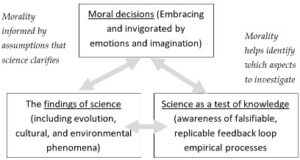
Thus, a Modern Humanist morality is grounded not in fear, but in reason and well-being. Meaning is created, not given. Humanism evolves with evidence, adapts to context, and resists harm.
Why did you focus on stewardship of Earth?
In my book I describe the collapse of the Aral Sea – once one of the largest inland lakes on earth. Other examples include the Minamata’s mercury poisoning, Lake Chad’s shrinkage, Papua New Guinea’s Ok Tedi mine disaster, global bee colony collapse, and China’s Three Gorges Dam. All these examples reveal how technocratic-short-sighted solutions unleash ecological and human devastation. They also show that nature has an excellent memory and a terrible forgiveness policy.
So, the first reason for stewardship of earth is selfish – without such stewardship we are harmed. The next step is to understand that ecosystems are interdependent networks, and their unravelling threatens biodiversity of all other life forms. Earth’s systems are tightly interconnected. The Southern Ocean’s currents regulate global climate, and their weakening disrupts rainfall, fisheries, and carbon absorption. The Global Tipping Points Report identifies 21 critical thresholds, from Amazon collapse to Arctic ice loss, while also offering hope through 10 positive tipping points like solar and wind energy. Every fraction above 1.5°C increases the risk of irreversible change.
Restoration is possible but slow. Kazakhstan’s Kokaral Dam revived parts of the North Aral Sea, restoring fish stocks and local economies. Yet recovery is minimal and even that is far harder than prevention.
What right do we, chance occurrences through evolution, have to destroy other sentient life? E. O. Wilson called stewardship and conservation a moral imperative. The Aral Sea disaster drove extinction rates a thousand times above prehuman levels, erasing species and knowledge. The UN’s Secretary General António Guterres called it “the biggest ecological catastrophe of our time,” warning that without urgent climate action, such tragedies will multiply. Stewardship of Earth must be central to everything we do.

What responsibilities do we owe future generations?
We are the beneficiaries and survivors of earlier generations. We similarly have a responsibility to the long term – including future generations.
Reframing stakeholders from just immediate concerns to the longer term reveals an essential truth: moral decisions must weigh not just immediate risks, but long-term generational impact. For example, public health must be inclusive: biologically, socially, and temporally. Humanism demands that decisions reflect a wide circle of stakeholders, including the vulnerable, and consider consequences across generational time scales.
The Iroquois have an admirable “Seventh Generation principle,” where in any important discussions, one tribe member represented future generations. We might do well to institute a similar system worldwide. Imagine if every modern parliament had such a representative — preferably someone who could ask, “Will this policy make our great‑great‑grandchildren curse us?”
Some cultures reflect this idea: In Wales, the “Future Generations Commissioner” literally exists to prevent short‑termism, in Bhutan, Gross National Happiness includes environmental and cultural preservation for future citizens, and even in science fiction — from Star Trek to The Expanse — we are repeatedly warned about what happens when we ignore long‑term consequences.
How can humanism help societies facing inequality and division?
Addressing inequality is part of Modern Humanism looking at wider stakeholders.
History’s legacy is alive in the present. Colonialism, industrialization, and ideological conflict still shape inequality, ecological harm, and cultural identity. Humanists study these forces not to assign blame, but to understand how inherited narratives shape today’s challenges. As Whitehead said, “A science which hesitates to forget its founders is lost,” progress demands historical awareness and the courage to evolve.
Humanism helps by encouraging dialogue grounded in shared humanity rather than inherited labels. It promoting policies based on scientific evidence and supports education, healthcare, and opportunity as universal goods. Examples include the Truth and Reconciliation Commissions in South Africa and Canada and the participatory budgeting in Brazil, which reduced inequality and increased civic trust.
Modern Humanism encourages the experimentation of different social structures and schemes. Among the boldest of experiments are trials of universal basic income—unconditional cash transfers. The results challenge the stereotype of the poor as free riders (people who benefit from a service or resource without contributing to its cost or upkeep).
In Finland, unemployed recipients of €560/month showed improved mental health and worked more. Ireland’s basic income for artists increased creative output and reduced anxiety. Barcelona’s B-MINCOME improved housing stability and community participation. Kenya’s GiveDirectly reached 20,000 people, boosting entrepreneurship, health, and social cohesion.
Other experiments show uneven reform. Brazil’s Bolsa Família affirms protection but falls short of universal capital. South Africa has progressive taxation but lacks ownership transparency. France and Nordic states embrace wealth taxes and labour rights, yet global coordination remains elusive.
But these trials suggest the need for coherent policy architectures that integrates redistribution, regulation, and democratic participation as a unified strategy of self-correction. There is no easy way and no promise of perfection — but humanism has the willingness to revise our mistakes and move towards better outcomes.

What inspired you to write this book?
As a teenager, I was electrified by feedback mechanisms and empiricism — a self-correcting learning process. Revising beliefs with evidence felt honest and subversive. I admired Charles Darwin’s temper of mind: “I have steadily endeavoured to keep my mind free so as to give up any hypothesis, however much beloved (and I cannot resist forming one on every subject), as soon as facts are shown to be opposed to it.” What a brave statement!
Though I earned Master’s degrees in Physics, I left science for business, completing an MBA. Instead of escaping Plato’s cave, I walked into it. Yet the commercial world taught me much about human nature. Facing my own vulnerabilities, living amid poverty and ecological destruction in India, and caring for family members strengthened my compassion and awareness.
At fifty (I am now sixty-one), I reengaged with science, the arts, and philosophy, exploring what it means to live a well-thought life. This book began over a decade ago, shaped by workshops, case studies, and conversations that opened new paths of thought.
The journey continues and there will always be much to learn.

What gives you hope for the future?
There is much cause to be a resigned pessimist. Stephen Emmott’s “Ten Billion,” concludes that Earth’s system will go into a “runaway” process, a tipping point like that of a fever over 42 degrees C. He says, “I hope I’m wrong, but the science points in my not being wrong.”
I resonate more with Daniel Ellsberg who, responding to the questions “Do you find yourself being cynical about our future? Is it possible to change the course of history?” said: “I can’t bring myself to say that the odds are any more than low. But it’s not impossible. My own case shows that. The challenge will be with us all the way. But is it worth trying? Yes.” As Albert Camus also wrote “there is only one honourable choice: to wager everything on the belief that in the end words will prove stronger than bullets.”
Where can readers find your book?
The book is available in eBook, paperback and hardcover formats across most online platforms including Amazon, Apple, Barnes and Noble, Kobo, and Google Play store.