

By the South African Secular Society
You don’t need a god to be good. You don’t need the promise of heaven to treat people with kindness, or the threat of hell to stop you from doing wrong. Millions of people across the world live rich, ethical, meaningful lives without religion ~ and many of them call themselves Humanists. But what exactly does that mean? And why does it matter, particularly here in South Africa?
A Philosophy as Old as Thought Itself
Humanism didn’t begin with the Enlightenment or the printing press. Its roots stretch back to ancient Greece, where the philosopher Protagoras declared, “Man is the measure of all things” ~ a radical idea that placed human experience, rather than divine authority, at the centre of understanding the world.

During the Renaissance, thinkers across Europe rediscovered the classics and began celebrating human creativity, dignity, and potential. Then came the Enlightenment ~ that extraordinary period when reason, science, and the rights of individuals began to displace superstition and absolute religious authority as the foundations of public life.
Modern Humanism as a formal life stance took shape in the 20th century. The first Humanist Manifesto was published in 1933, followed by updated versions in 1973 and 2003. International organisations like Humanists International now unite millions of people across dozens of countries who share a commitment to reason, compassion, and human flourishing ~ without recourse to the supernatural.
What Do Humanists Actually Believe?
Humanism is not a creed with fixed dogmas. It is a life stance ~ a way of approaching existence based on a handful of core commitments.
Reason and critical thinking. Humanists believe that the best way to understand the world is through evidence, science, and rational enquiry. We don’t dismiss mystery or wonder ~ quite the opposite. But we think the tools of reason serve us far better than faith in authority or ancient texts.
Ethics without God. One of the most common questions Humanists encounter is: “If you don’t believe in God, what stops you from doing terrible things?” The Humanist answer is straightforward: empathy, reason, and a genuine concern for human wellbeing. Morality doesn’t require a divine lawgiver. It grows from our capacity to feel, to think, and to recognise that other people’s suffering matters.
Human dignity and autonomy. Every person has inherent worth ~ not because a deity decreed it, but because we are conscious beings capable of joy, suffering, love, and loss. Humanists are strong advocates for individual rights, bodily autonomy, gender equality, LGBTQ+ inclusion, and freedom of conscience.
Science and democracy. Humanists trust tested knowledge over tradition, and free societies over authoritarian ones. Science is not the enemy of wonder; it is its finest expression.
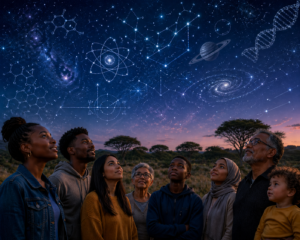
This life is what we have. Without belief in an afterlife, Humanists hold that this world ~ this brief, luminous existence ~ deserves our full attention and care. That’s not a cause for despair. It’s a call to live well, love generously, and work for a better future.
What Humanism Is Not
It is worth clearing up a few misconceptions.
Humanism is not simply atheism, though many Humanists are atheists. Atheism is the absence of belief in gods; Humanism is an affirmative philosophy about how to live. You can be an atheist without being a Humanist, and ~ in principle ~ some religious liberals consider themselves aligned with Humanist values.
Humanism is also not anti-religious or hostile to religious people. Humanists disagree with supernatural beliefs, but they do not regard religious individuals as foolish or wicked. Respect for persons is central to the Humanist ethic.
And Humanism is emphatically not moral relativism. Humanists hold that some things genuinely are better or worse for human beings, and that we can work out what those things are through reason and compassion. That is not a weak foundation ~ it is a deeply serious one.

Humanism in Everyday Life
How does Humanism play out in practice? How does a Humanist find meaning, face grief, or raise children?
Meaning, for Humanists, is found in relationships, creativity, contribution, and the sheer astonishment of being alive in an extraordinary universe. It is not handed down from above ~ it is made, together, here on earth.
Facing death without the comfort of an afterlife requires honesty. Many Humanists find that accepting mortality, rather than denying it, actually deepens their appreciation of life and the people they love. Humanist celebrants ~ trained secular officiants ~ now conduct funerals, weddings, and naming ceremonies across South Africa and around the world, offering meaningful rituals grounded in real human experience rather than religious doctrine.
Raising children as Humanists means teaching them to ask questions, to think for themselves, to feel empathy for others, and to understand that their worth is not conditional on belief. It means equipping them for the world as it is, not as ancient texts imagined it.

Humanism in South Africa
South Africa presents a fascinating tension. Our Constitution is among the most progressive in the world, enshrining human dignity, equality, and freedom of conscience ~ values that align closely with Humanist principles. And yet our public culture remains deeply and pervasively religious, with secular voices frequently marginalised or misunderstood.

For South Africans who have left religion, or who were never part of it, Humanism offers a coherent, positive framework for living ethically and finding community. It is not a void left by departing faith ~ it is a rich tradition in its own right, with a long history and a clear sense of purpose.
The South African Secular Society exists to support exactly this: to provide a home for secular thinkers, to advocate for a genuinely pluralistic public square, and to demonstrate that reason and compassion are more than sufficient foundations for a good life and a just society.
To read more about secular humanism in a South African read our blog Secular Humanism and Ubuntu.
A Final Thought
Humanism is not about having all the answers. It is about committing to ask better questions ~ and to face those questions honestly, together, with courage and curiosity.
If that sounds like the kind of life stance you’re drawn to, you’re in good company. Across centuries and continents, human beings have found that reason, empathy, and solidarity are not just enough to live by. They are, perhaps, the very best of what we are.
The South African Secular Society promotes reason, science, and humanist values in South Africa. To find out more, explore our website and follow us on social media.