
Introduction
South Africa is one of the most religiously diverse countries in the world. Our classrooms bring together children from Christian, Muslim, Hindu, Jewish, African Traditional, and many other faith backgrounds. Increasingly, they also include learners who identify as atheist, agnostic, humanist, or simply non-religious.
In a democratic society, schools have an important responsibility: to provide an education that respects this diversity while protecting every learner’s right to freedom of conscience. Yet concerns persist that some South African schools continue to promote particular religious beliefs in ways that go beyond education and enter the realm of indoctrination.
The question is not whether religion should exist in schools. The question is whether public schools should encourage learners to adopt specific religious beliefs, or whether they should create environments where all learners are free to develop their own views.
What Is Religious Indoctrination?
Religious indoctrination occurs when beliefs are presented as unquestionable truths and learners are encouraged to accept them without critical examination. It differs significantly from education about religion.
Education helps learners understand different religions, their histories, practices, and influence on society. Indoctrination seeks to persuade learners that one particular belief system is correct.
The distinction is important. A teacher explaining the role of Christianity, Islam, Hinduism, or African Traditional Religion in South African society is educating. A teacher presenting one religion as the only truth, or suggesting that those who do not believe are somehow deficient, is crossing into indoctrination.
Public schools should aim to equip learners with knowledge and critical thinking skills, not to shape their personal beliefs.
The Constitutional Framework
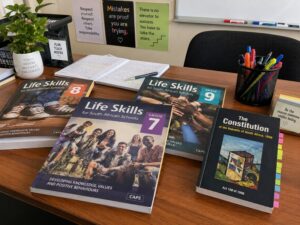
South Africa’s Constitution protects freedom of religion, belief, and opinion. It also guarantees equality and prohibits unfair discrimination.
These rights apply to all learners, including those who belong to minority religions and those who hold no religious beliefs at all.
Importantly, freedom of religion includes the freedom not to practise a religion. It includes the right to change one’s beliefs, question inherited traditions, and arrive at different conclusions from those of one’s family or community.
This principle was reinforced in 2017 when the High Court ruled that public schools may not promote or endorse a single religion to the exclusion of others. The judgment clarified that public schools must remain inclusive institutions that serve all members of society, regardless of their beliefs.
The ruling did not prohibit religious expression. Rather, it affirmed that public schools should not identify themselves with one particular faith tradition in ways that exclude others.
How Religious Indoctrination Can Occur in Schools
Religious indoctrination is not always obvious. Often it takes the form of everyday practices that have become so familiar that they are rarely questioned.
School Assemblies
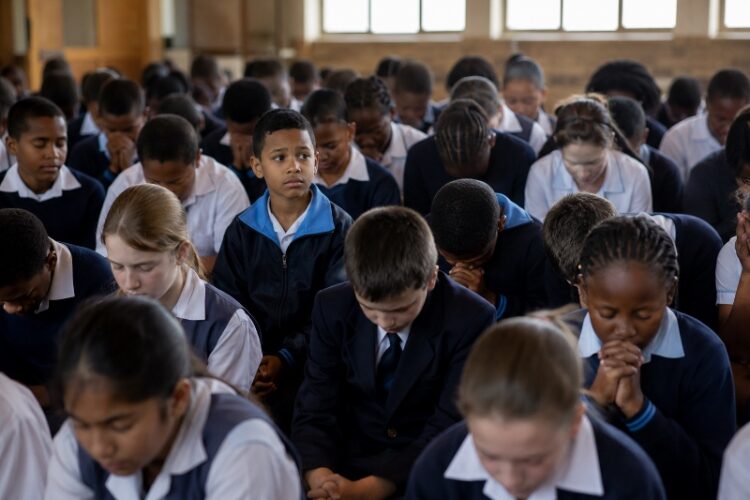
Many learners begin their school day with prayers, religious readings, or worship activities associated with a particular faith.
For learners who share those beliefs, such practices may feel entirely normal. For others, they can create a sense of exclusion.
A non-religious learner recently described the experience this way:
“Every assembly starts with prayer, and everyone around me bows their heads. If I don’t join in, I get strange looks. Sometimes teachers talk as if everyone believes in God. It makes me feel invisible.”
Even when participation is technically voluntary, social pressure can make opting out difficult.
Classroom Practices
Problems may also arise when teachers present personal religious beliefs as established facts or imply that certain viewpoints are morally superior.
Learners should be encouraged to ask questions and explore ideas. They should never feel pressured to adopt a particular worldview in order to gain approval or avoid criticism.
School Identity and Culture
Some public schools continue to describe themselves in explicitly religious terms or maintain traditions that assume all learners belong to a particular faith.
While these practices may reflect historical traditions, they can send an unintended message that some learners belong more fully than others.
Peer Pressure
Religious conformity is not always enforced by adults. Learners themselves may exclude, mock, or stigmatise classmates whose beliefs differ from the majority.
Children and teenagers are highly sensitive to social acceptance. A learner who feels different may choose to remain silent rather than risk standing out.
The Impact on Learners
The effects of exclusion can be significant.
For non-religious learners, constant exposure to practices that assume religious belief may create feelings of isolation and invisibility. Some report hiding their views to avoid awkward conversations or negative reactions.
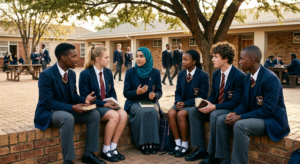
Learners from minority faiths may experience similar challenges. They may feel pressure to participate in activities that conflict with their own beliefs or feel that their traditions are less valued than those of the majority.
Beyond questions of religion, there is also a broader educational concern. Schools should cultivate independent thinking. When learners are taught that certain ideas must not be questioned, opportunities for critical inquiry are diminished.
A healthy educational environment encourages curiosity, evidence-based reasoning, and respectful disagreement.
Common Arguments in Defence of Religious Practices
Supporters of current practices often raise several arguments.
“It’s Our Tradition”
Traditions can provide continuity and a sense of community. However, South Africa today is far more diverse than it was when many school traditions were established.
The existence of a tradition does not automatically justify its continuation if it excludes some members of the school community.
“Participation Is Voluntary”
In theory, many religious activities are optional. In practice, opting out can be uncomfortable, especially for young people who do not want to draw attention to themselves.
The question is not simply whether learners are allowed to refuse participation. It is whether they can do so without feeling isolated or stigmatised.
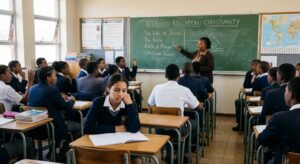
“Religion Teaches Morality”
Religious traditions have contributed valuable ethical teachings. However, morality is not the exclusive property of religion.
People of many faiths, as well as those with no religious beliefs, are capable of compassion, honesty, responsibility, and concern for others.
Public schools can promote shared ethical values without endorsing any particular religious doctrine.
Building Truly Inclusive Schools
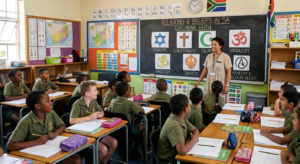
The goal should not be to remove religion from society or to prevent religious learners from expressing their beliefs. Rather, it should be to ensure that public schools are welcoming to everyone.
Schools can achieve this by:
- Teaching about religions rather than promoting one religion. (Read more about the difference betwen religious instruction and religion education.)
- Including non-religious worldviews such as Humanism in discussions of belief and ethics.
- Creating assemblies that are inclusive of all learners.
- Encouraging critical thinking and open inquiry.
- Ensuring that learners who choose not to participate in religious activities are treated with equal respect.
- Fostering a culture of mutual understanding and dialogue.
Such measures benefit everyone, not only non-religious learners.
The Role of Parents and Communities
Parents play a vital role in shaping their children’s values and beliefs. Public schools should support this role by respecting the diversity of convictions represented within their communities. When concerns arise, constructive dialogue between parents, educators, and school governing bodies is often more productive than confrontation.
The objective should be to create environments where every learner can thrive, regardless of what they believe.
The SA Secular Society offers assistance to parents who find that there are religious practices at their child’s public school. This is particularly important if they feel their child is being discriminated against for their non-religious beliefs.
Conclusion
Public schools belong to all South Africans. They should be places where learners from every religious and non-religious background feel respected, included, and free to think for themselves.
Religious freedom is one of the cornerstones of a democratic society. But that freedom must apply equally to everyone. It must protect the right to believe, the right to practise a religion, the right to change one’s beliefs, and the right not to believe at all.
The purpose of education is not to produce followers of any particular worldview. It is to equip young people with the knowledge, critical thinking skills, and intellectual independence they need to make their own informed choices.
A truly inclusive school does not tell learners what to think. It teaches them how to think.